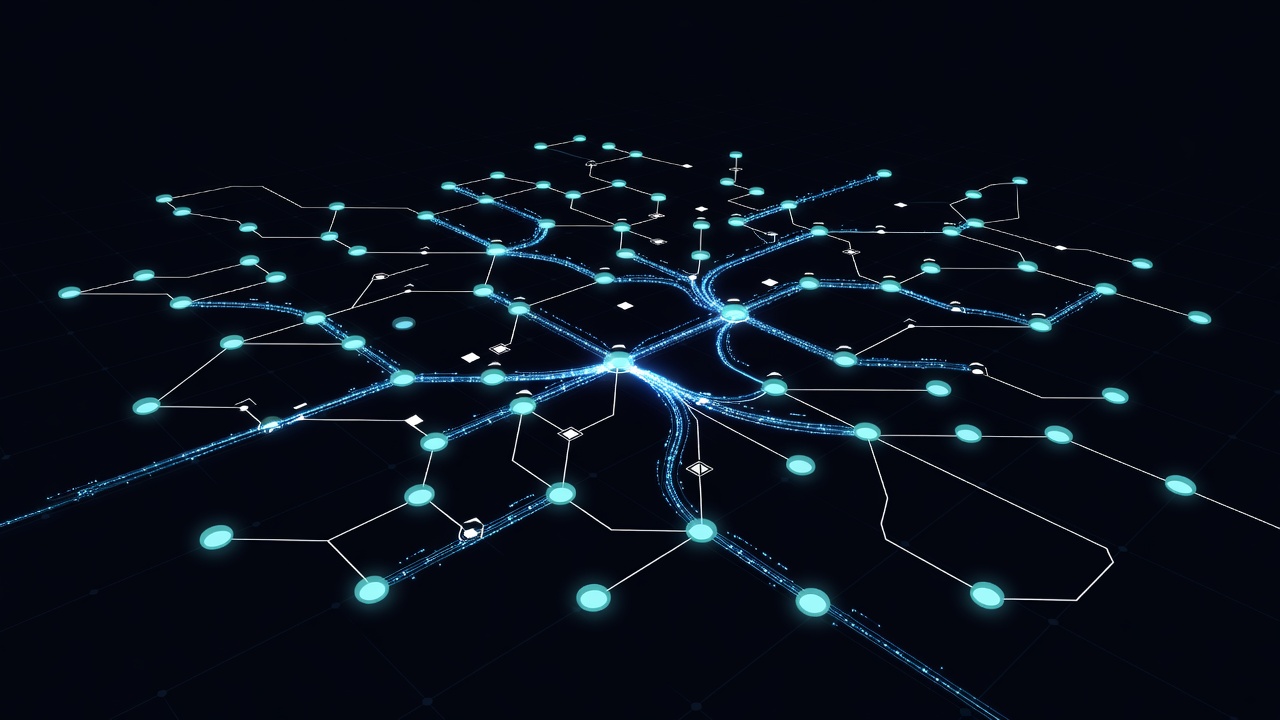
Why Linear Chains Fall Short in Production
Most introductory LLM applications begin with simple chains: a prompt, a model call, perhaps a tool invocation, and an output. These patterns work for demos but reveal serious limitations when moved into production environments serving real users.
Real-world tasks are rarely linear. An AI customer support agent may need to query a database, ask clarifying questions from a human, retry failed API calls, or escalate to a specialist. These behaviors require memory across multiple steps, conditional routing, and the ability to pause and resume execution. LangGraph, developed by the LangChain team, addresses these needs by representing LLM workflows as computational graphs.
Unlike DAG-based orchestration tools, LangGraph explicitly supports cycles, persistent checkpoints, and dynamic state updates. This makes it particularly suitable for agentic systems where an LLM decides the next action based on evolving context.
Core Abstractions in LangGraph
LangGraph builds on three primary concepts: State, Nodes, and Edges. The State is a typed dictionary or Pydantic model that carries data between steps. Nodes are functions that receive the current state and return updates. Edges define the control flow, either static or conditional.
A typical graph begins with a START node and ends at an END node, but the interesting behavior happens in the cycles. For example, an agent node can route to a tool node, which routes back to the agent node with new observations. This create-think-act loop is the foundation of ReAct-style agents.
The framework uses a reducer pattern for state updates. When multiple nodes return values for the same key, a predefined reducer function merges them. The most common example is appending new messages to a conversation history rather than overwriting it.
Implementing a Basic Research Agent
Consider a research assistant that can search the web, read pages, and synthesize findings. Using LangGraph, we define a state schema and a set of nodes.
from typing import TypedDict, Annotated, Literal
from langgraph.graph import StateGraph, START, END
from langgraph.graph.message import add_messages
from langchain_core.messages import BaseMessage

class AgentState(TypedDict):
    messages: Annotated[list[BaseMessage], add_messages]
    next_action: Literal["search", "read", "synthesize", "end"]

def agent_node(state: AgentState):
    # LLM decides next tool or final answer
    ...
    return {"messages": [response], "next_action": decision}

def search_node(state: AgentState):
    # Call Tavily or similar
    ...
    return {"messages": [ToolMessage(content=results)]}
The graph construction looks like this:
workflow = StateGraph(AgentState)
workflow.add_node("agent", agent_node)
workflow.add_node("search", search_node)
workflow.add_node("read", read_node)
workflow.add_node("synthesize", synthesize_node)

workflow.add_conditional_edges(
    "agent",
    lambda s: s["next_action"],
    {
        "search": "search",
        "read": "read",
        "synthesize": "synthesize",
        "end": END
    }
)

workflow.add_edge("search", "agent")
workflow.add_edge("read", "agent")
workflow.add_edge("synthesize", "agent")
workflow.add_edge(START, "agent")

graph = workflow.compile()
Persistence and Checkpointing
One of LangGraph's strongest production features is built-in persistence through checkpointers. A checkpointer saves the graph state after each node execution, allowing the workflow to be paused and resumed later—even after a server restart.
PostgreSQLCheckpointer and SQLiteCheckpointer are provided out of the box. For high-scale deployments, teams implement custom checkpointers backed by Redis or DynamoDB.
from langgraph.checkpoint.postgres import PostgresSaver

checkpointer = PostgresSaver.from_conn_string("postgresql://...")
graph = workflow.compile(checkpointer=checkpointer)

# Execute with thread_id for conversation continuity
config = {"configurable": {"thread_id": "user-123"}}
result = graph.invoke(initial_input, config)
This pattern enables several critical capabilities:
- Long-running research tasks that span hours or days
- Human-in-the-loop approval steps
- Recovery from rate-limit errors or transient failures
- Audit trails of every decision and tool call
Human-in-the-Loop Patterns
Production agents frequently need human oversight. LangGraph supports this through interrupt mechanisms. Developers can configure breakpoints before sensitive nodes such as those that send emails, charge cards, or modify critical data.
When the graph hits an interrupt, execution pauses and the system returns the current state. A human reviewer can then update the state (for example, approve or modify parameters) before resuming the graph from the exact checkpoint.
This pattern is implemented with minimal code:
graph = workflow.compile(
    checkpointer=checkpointer,
    interrupt_before=["send_email", "charge_card"]
)
The frontend application can expose these pending interruptions in an admin dashboard, allowing operations teams to review and act without breaking the agent's context.
Multi-Actor Coordination
Complex applications often require multiple specialized agents. LangGraph supports this through hierarchical graphs or supervisor patterns. A supervisor node uses an LLM to decide which specialist subgraph should handle the current task.
Each specialist maintains its own state but can communicate through a shared message bus or by returning structured artifacts to the parent graph. This approach reduces prompt size for each agent while maintaining clear separation of concerns.
Common multi-actor topologies observed in production systems include:
- Supervisor + specialists (researcher, writer, critic)
- Sequential handoff with handoff summaries
- Parallel execution with a synthesis step
- Debate architectures where agents critique each other
Security Considerations for Agent Systems
Agentic systems introduce new attack surfaces. Because agents can call tools and make autonomous decisions, developers must treat every tool as a potential privilege escalation vector.
Key defenses include:
- Strict tool permission boundaries tied to user sessions
- Output validation and schema enforcement on all tool responses
- Sandboxed execution environments for code interpreters
- Rate limiting and cost controls on external API calls
- Comprehensive logging of every model invocation and tool use for forensic analysis
Prompt injection remains a concern, especially when agents process untrusted user data or web content. Using separate models for planning versus tool execution, or applying output guards, can reduce risk. Teams should also implement canary prompts that test for manipulation before critical actions.
Observability and Monitoring
Production LangGraph deployments require visibility into graph execution. LangSmith provides native tracing, but many organizations export traces to OpenTelemetry collectors for unified observability with their existing infrastructure.
Important metrics to track include:
- Step latency per node type
- Tool success and failure rates
- Token consumption per workflow
- Frequency of human interventions
- Recovery rate from interrupted states
Setting alerts on unexpected routing patterns or sudden increases in loop iterations helps catch prompt drift or malicious inputs early.
Deployment and Scaling Strategies
For low-latency use cases, self-hosted models paired with LangGraph running in the same Kubernetes cluster minimize network hops. For broader capability, teams often use API-based models while keeping the graph execution engine geographically close to their users.
State persistence layer choice significantly affects scalability. Postgres works well up to moderate throughput; beyond that, teams migrate to specialized solutions like Redis streams or Apache Kafka for checkpoint storage.
Horizontal scaling is achieved by running multiple stateless instances of the graph execution service. Because state lives in the checkpointer, any instance can resume any thread, enabling straightforward load balancing.
Trade-offs and When Not to Use LangGraph
LangGraph adds complexity. For simple question-answering or single-turn tasks, a well-engineered chain or direct API call remains more maintainable. The graph abstraction shines when workflows involve multiple conditional branches, memory across days, or multiple autonomous actors.
Debugging cyclic graphs can be challenging. Developers should start with small, well-defined graphs and expand only after establishing solid observability. Overly complex graphs with dozens of nodes often indicate that the problem should be decomposed into separate services.
Real-World Impact on Startups
Early-stage companies using these patterns report faster iteration on AI features because the graph structure makes it easy to insert new tools or modify routing logic without rewriting prompt chains. The persistence layer also simplifies demo-to-production transitions—many teams ship with SQLite checkpointers during beta and migrate to Postgres for GA.
The ability to add human oversight without rewriting business logic has proven especially valuable for regulated industries or any product handling financial or personal data.
Conclusion
LangGraph represents a significant evolution in how developers orchestrate LLM-powered systems. By treating agent workflows as stateful, persistent graphs, teams gain the reliability, auditability, and control necessary for production use cases that go far beyond chatbots.
The patterns explored here—careful state design, checkpointing, human-in-the-loop interrupts, multi-actor coordination, and rigorous security controls—provide a foundation for building AI products users can actually trust. As the ecosystem matures, expect tighter integration with observability platforms, more enterprise-grade checkpointers, and higher-level abstractions that hide graph complexity while preserving its power.
For full-stack teams already shipping LLM features, investing time in LangGraph delivers compounding returns as product requirements grow from simple assistants to sophisticated, long-lived autonomous systems.