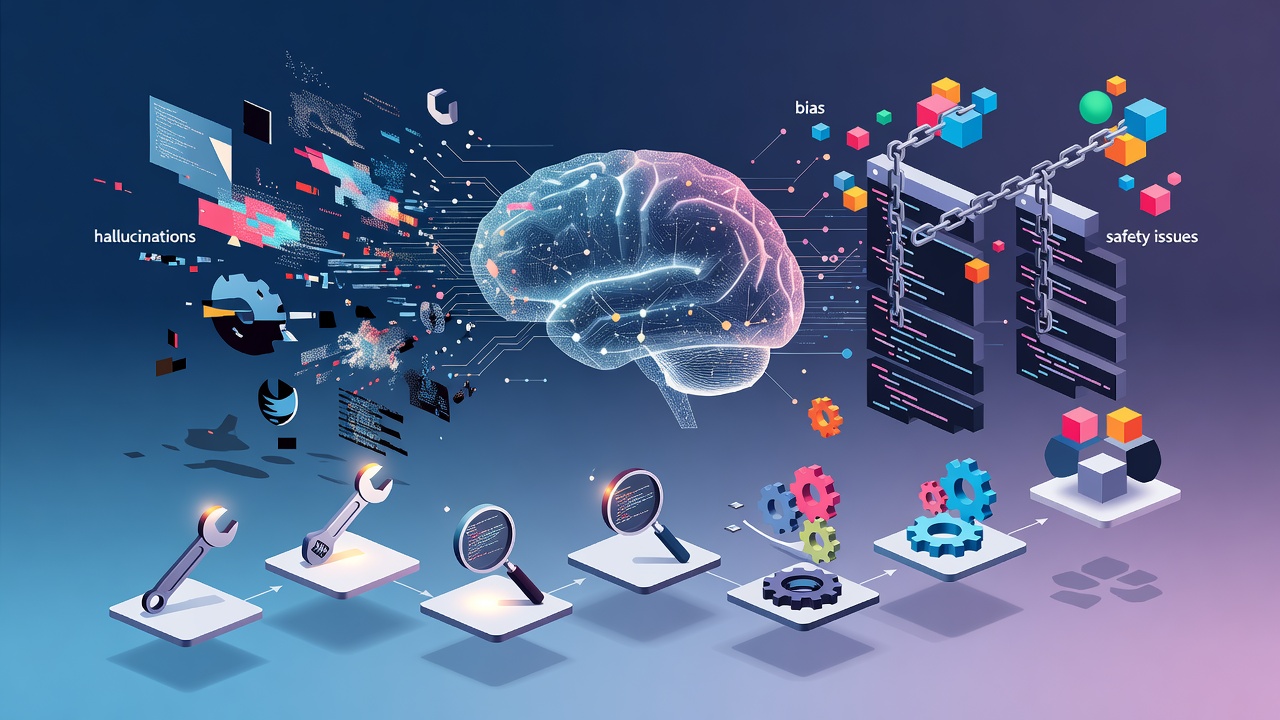
Artificial intelligence continues to expand into applications ranging from code assistants to decision support tools. As models grow larger and more integrated into daily workflows, attention turns to the bugs that appear during development and deployment, along with broader safety questions.
Recognized Limitations in Current AI Systems
AI models can produce incorrect or inconsistent outputs even when trained on large datasets. One frequent example is hallucination in language models, where plausible-sounding but false information is generated. Another issue is data drift, where performance drops because input patterns change over time after deployment.
Bias in training data often carries through to results. A hiring-screening model might favor certain demographic groups if historical records reflect past imbalances. Adversarial inputs, such as slightly altered images or text, can also cause misclassifications that were not observed during testing.
Safety Considerations for Wider Adoption
Safety extends beyond technical errors to questions of alignment with human intent and potential misuse. When an AI system controls physical processes or handles sensitive decisions, unexpected behavior can lead to harm. Prompt injection attacks, where users craft inputs to override original instructions, have been documented in chat-based interfaces.
Another area involves over-reliance. Teams that integrate AI recommendations without verification steps may miss edge cases. Regulatory discussions in several regions now focus on transparency requirements and audit trails for high-impact uses.
Practical Steps to Reduce Bugs
- Implement continuous evaluation pipelines that compare model outputs against held-out test sets and real-world feedback loops.
- Use techniques such as adversarial training to expose models to perturbed examples during development.
- Version datasets and track changes so that performance shifts can be traced to specific data updates.
- Combine multiple models or add rule-based checks for critical outputs to catch obvious errors before they reach users.
Approaches to Improve Safety
Developers can start by defining clear boundaries for what an AI system is allowed to do. Red-teaming exercises, where internal teams attempt to find failure modes, help surface risks early. Logging all inputs and outputs supports later audits without exposing production traffic.
Small businesses often benefit from starting with narrow, well-scoped tasks rather than broad autonomous agents. For instance, using an AI tool to draft code suggestions while keeping final review with a human developer limits exposure. Regular monitoring of key metrics, such as accuracy on recent data slices, provides early warning when behavior changes.
Looking Ahead
Progress in AI will likely continue through iterative improvements in training methods and evaluation practices. Public research on robustness and alignment offers reusable patterns that teams can adapt. By focusing on measurable testing, scoped deployments, and ongoing oversight, developers and founders can build systems that deliver value while keeping known risks under control.